


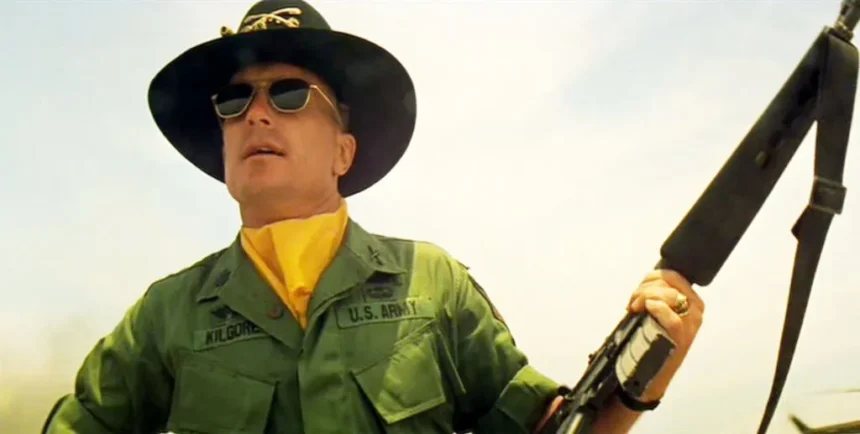
The Oscar-winning actor, known for ‘The Godfather’ and ‘Apocalypse Now,’ has passed away at 95, leaving behind a legacy that defined American cinema.
There are actors, and then there are actors who become the characters they play. Robert Duvall belonged firmly in the latter category.
On Sunday, the entertainment world lost one of its true giants. Robert Duvall, the man who brought us the stoic Tom Hagen, the napalm-loving Lieutenant Colonel Kilgore, and the washed-up but hopeful country singer Mac Sledge, died peacefully at his home in Middleburg, Virginia. He was 95.
The news, confirmed by his wife Luciana, marks the end of a six-decade career that didn’t just include classic films—it defined them.
“He Was Simply Everything”
In a world often flooded with generic statements from publicists, the tribute from Duvall’s wife, Luciana, felt as genuine as the man himself.
“To the world, he was an Academy Award-winning actor, a director, a storyteller. To me, he was simply everything. His passion for his craft was matched only by his deep love for characters, a great meal, and holding court.”
That phrase—”holding court”—paints a perfect picture of the Duvall we all imagined: a storyteller’s storyteller, equally passionate about barbecue as he was about acting.
The Godfather Connection
When you think of The Godfather, your mind might jump to Marlon Brando’s mumbling Don, or Al Pacino’s quiet transformation into Michael. But the film’s emotional anchor was always Robert Duvall’s Tom Hagen, the loyal consigliere who wasn’t blood, but was family.
Al Pacino, his co-star, released a touching tribute that highlighted the respect between two titans:
“It was an honour to work with him. He was a born actor as they say, his connection with it, his understanding and his phenomenal gift will always be remembered. I will miss him.”
Francis Ford Coppola, who directed Duvall in both The Godfather and Apocalypse Now, called the loss “a blow.” On Instagram, the legendary director acknowledged Duvall as “such a great actor and such an essential part of American Zoetrope from its beginning.”
“I Love the Smell of Napalm in the Morning”
If there is a single line that will echo through film history for another century, it’s that one.
In Apocalypse Now, Duvall had limited screen time, but he turned Lieutenant Colonel Bill Kilgore into a cultural phenomenon. The character, originally named “Captain Carnage,” was supposed to be even more over-the-top, but Duvall did what he always did: he did his homework.
“I did my research,” Duvall once told Larry King.
The result? A terrifying, charismatic, surfboard-wielding officer whose love for the chaos of war was summed up in a moment of brutal poetry. It wasn’t just a line; it was a masterclass in character building.
More Than the Tough Guy
While he was synonymous with “tough guys,” Duvall’s range was staggering. He could break your heart without saying a word.
Remember his screen debut? In 1963’s To Kill a Mockingbird, he played Boo Radley. As Alec Baldwin noted in a tribute, “He used not a single word of dialogue, not a single word, and he just shatters you.”
He won his Oscar not for a gangster or a soldier, but for playing a broken country singer finding redemption in Tender Mercies. He was a bullying executive in Network, a complicated father in The Great Santini, and a Texas Ranger in the beloved miniseries Lonesome Dove—a role he often cited as his personal favorite.
A Man of Simple Pleasures
The tributes pouring in reveal a man who was as beloved off-screen as he was on-screen.
Adam Sandler, who worked with Duvall on the 2022 film Hustle, remembered him fondly: “Funny as hell. Strong as hell. One of the greatest actors we ever had. Such a great man to talk to and laugh with.”
Robert Patrick, who played his son in Jayne Mansfield’s Car, shared a wonderfully human memory: “Over the years I would call Bobby and we’d talk movies and barbecue. He loved barbecue.”
It’s a detail that feels perfectly Duvall. For a man who spent his life pretending to be other people, the real Robert Duvall was simply someone who loved a great meal, a great story, and the people he shared them with.
The Legacy
In the end, his wife’s statement captured it best:
“For each of his many roles, Bob gave everything to his characters and to the truth of the human spirit they represented. In doing so, he leaves something lasting and unforgettable to us all.”
Robert Duvall is gone, but don’t ever think we’ve lost him. He’s still there, in the shadowy corner of the Corleone estate, on the windy beaches of Vietnam, and in the dusty heart of Texas.
He was the greatest consigliere the screen has ever seen. Rest in peace, Mr. Duvall.
What is your favorite Robert Duvall performance? Let us know in the comments below.