


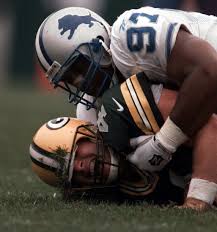
The Detroit Lions have lost one of their own.
On February 9, 2026, Tracy L. Scroggins—a defensive end and linebacker who spent his entire ten-year NFL career wearing Honolulu blue—passed away at age 56. And while his stat line tells one story, the full measure of the man extends far beyond the gridiron.
From Checotah to the Silverdome
Born September 11, 1969, in Checotah, Oklahoma, Scroggins was the kind of athlete small towns build legends around. He didn’t just play football at Checotah High School—he competed in basketball and track too, developing the blend of speed, power, and relentless motor that would define his professional career.
His path to the NFL wasn’t a straight line. Junior college at Coffeyville Community College first. Then the University of Tulsa, where he developed into a prospect worthy of professional football.
When the Lions selected him 53rd overall in the second round of the 1992 NFL Draft, they likely hoped they were getting a contributor. What they got instead was a franchise cornerstone.
A Decade in Detroit
Over 142 games and 89 starts, Scroggins amassed 321 tackles and 60.5 sacks—numbers that still place him among the Lions’ all-time leaders. His 1995 campaign remains the standard: 9.5 sacks and 45 tackles, a season that announced his arrival as one of the NFC’s most disruptive defensive players.
But statistics never quite captured what made Scroggins special. He played with an edge—the kind that opposing offensive linemen dreaded and teammates revered. He was reliable, durable, and wholly committed to an organization that wasn’t always winning during his tenure.
In an era of constant movement and free agency, Scroggins stayed. Detroit drafted him. Detroit got his entire career. That kind of loyalty feels almost antiquated now.
The Hardest Hit
Football gave Tracy Scroggins everything—and then it took something back.
Following his retirement in 2001, Scroggins became increasingly vocal about the long-term health challenges facing former players. In 2016, he took the extraordinary step of filing a lawsuit against the NFL after receiving a preliminary diagnosis of chronic traumatic encephalopathy (CTE)—the degenerative brain condition linked to repeated head trauma.
This wasn’t abstract advocacy. This was personal.
His family has since shared that the disease profoundly affected him in his final years. They believe it contributed to his early death, though no official cause has been released. It’s a painful, familiar story in football now—but each loss reminds us that behind every diagnosis is a human being, a former teammate, a father, a friend.
What Remains
Tracy Scroggins was never the most famous Lion. He wasn’t a Hall of Famer or a household name outside Detroit. But he was their player—a second-round pick who outperformed his draft slot, who gave a decade to one city, and who, when his playing days ended, used his voice to protect the next generation.
The CTE lawsuit wasn’t about money. It was about acknowledgment. About accountability. About hoping that the boys coming up behind him wouldn’t face the same struggles he did.
When we remember Tracy Scroggins, we remember the 60.5 sacks and the 1995 season and the years he spent chasing quarterbacks in the Silverdome. But we also remember the Checotah kid who made good, the advocate who fought long after his cleats were hung up, and the man whose final years were shaped by the very game that made him.
Rest well, No. 91. The game loved you—even if it didn’t always love you back.
The Scroggins family has not announced memorial service details. In lieu of flowers, they request consideration for organizations supporting brain health research for former athletes.