


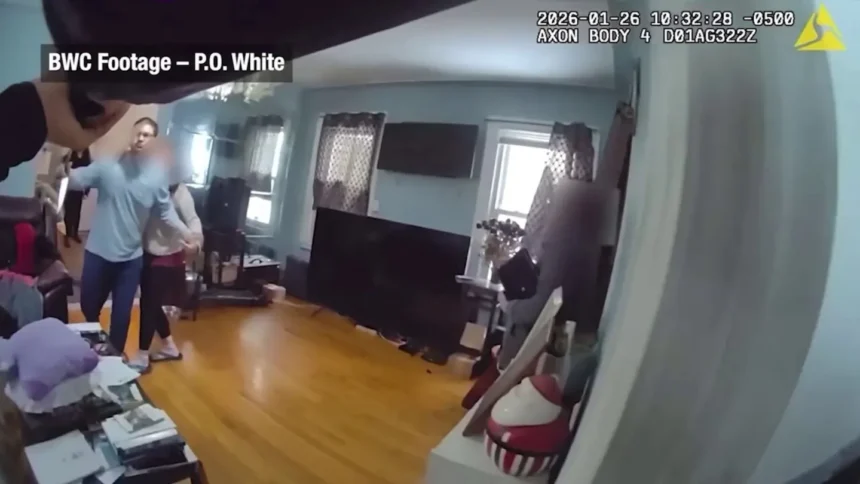
This week, the NYPD released body camera footage from a January incident in Queens that cuts to the heart of a national dilemma: How do we respond to emergencies involving mental health? The video is difficult to watch, the facts are distressing, and the aftermath reveals a stark divide in how we seek solutions. It’s a story about a family’s call for help, an officer’s split-second decision, and a mayor’s plea for a different system entirely.
The Incident: A Family’s Call for Help
On January 26, the family of 22-year-old Jabez Chakraborty, a young man living with schizophrenia, dialed 911. They reported he was experiencing a mental health episode and had thrown a glass. Crucially, the caller requested an ambulance and EMS, asking for him to be taken involuntarily to the hospital—they were calling for medical help, not police.
When NYPD officers arrived at the Queens home, they found Chakraborty holding a large kitchen knife. The released footage shows officers attempting to de-escalate, repeatedly commanding, “Put the knife down.” A woman, presumably a family member, tries to intervene with her arm. The officer retreats, closing a door between himself and the living room. According to police, Chakraborty then pushed through that door, stepping forward with the knife. The officer fired, striking Chakraborty four times. He survived and remains in intensive care in stable but critical condition.
The Aftermath: Treatment vs. Prosecution
Here is where the narrative fractures. The Queens District Attorney’s office is investigating, with reports suggesting they are considering an attempted murder indictment. Meanwhile, New York City Mayor Zohran Mamdani held a news conference, stating a very different path forward.
“What Jabez needs is mental health treatment, not criminal prosecution,” Mamdani said, emphasizing the pain of the family and Chakraborty’s long history with schizophrenia. He pointed to the core of his policy vision: “A person experiencing a mental health episode does not always have to be served first or exclusively by a police officer.”
This is not just rhetoric. Mayor Mamdani has championed programs to replace police officers with social workers and “transit ambassadors” on certain 911 calls—a move toward a public health response to crises that have traditionally fallen on law enforcement.
The Uncomfortable Questions This Footage Forces Us to Ask:
-
The 911 Dilemma: When a family calls for an ambulance, should police be the first responders? Our emergency dispatch systems often blur the lines between medical crisis and public threat, with potentially tragic results.
-
The Officer’s Reality: Proponents of alternative response teams argue this is precisely the situation they are trained to handle without force. Yet, in this moment, the officer faced an immediate, armed threat. Could a different team have safely managed this? Is it fair to expect police to be both warriors and therapists?
-
Justice or Healing? Does prosecuting a individual in the throes of a psychotic episode serve justice? Or does it criminalize illness and compound trauma for a vulnerable person and their family?
Closing Thoughts:
The bodycam footage from Queens is more than a video; it’s a case study. It shows a scared family, a terrified young man, and an officer forced into a no-win scenario. It also highlights the growing chasm between traditional law-and-order protocols and a progressive push for a compassionate, health-centered approach.
Mayor Mamdani’s comments are a direct challenge to the status quo. Whether you agree with his solutions or not, this incident demands we ask harder questions about our systems. Can we build a response network that ensures both public safety and humane care for our most vulnerable? The future of 911 may depend on our answer.
What do you think? Should cities invest more in non-police emergency response teams for mental health calls? Share your thoughts in the comments below.